What Happens When You Call 999?
Why your Eircode could save vital minutes.
It is a number most of us hope never to dial, yet Ireland's emergency lines received 2.19 million calls in 2024 alone. Between the moment you dial and the moment help arrives, your call passes through a chain of operators, triage software, location technology and volunteers. Here is how it works, and why the single most useful thing you can do today is learn your Eircode.
The First Voice You Hear
When you dial 999 or 112 anywhere in Ireland, you are first answered by the Emergency Call Answering Service (ECAS), operated under State concession by BT Communications Ireland from centres in Navan, Co Meath and Ballyshannon, Co Donegal. BT has run the service since July 2010, calls are free to the caller, and the service is funded through a call handling fee levied on the phone networks.
The operator's job is to establish which service you need: An Garda Síochána, the ambulance service, the fire service or the Irish Coast Guard, with Air Traffic Control involved where aircraft are concerned. Your location is confirmed and the call transferred, with the ECAS operator remaining on the line until the emergency service accepts it.
According to official figures published on gov.ie, the ECAS received 2.19 million calls in 2024, with volumes in 2025 expected to be approximately the same. Not every call reaches a Garda or paramedic: in 2023, 56.4% of calls were filtered out as silent, accidental, hoax or non-emergency calls, while 43.6% were connected to an emergency service. Of the calls forwarded that year, the ambulance service accounted for 47%, An Garda Síochána 46%, and the fire services and Coast Guard the remaining 6%.
Inside the Ambulance Control Room
For medical emergencies, your call is transferred to the National Ambulance Service's National Emergency Operations Centre (NEOC), which operates across two sites in Tallaght and Ballyshannon, handling over 435,000 calls per year with more than 240 staff. It is an accredited International Academies of Emergency Dispatch Centre of Excellence, placing it in the top 10% of control rooms worldwide.
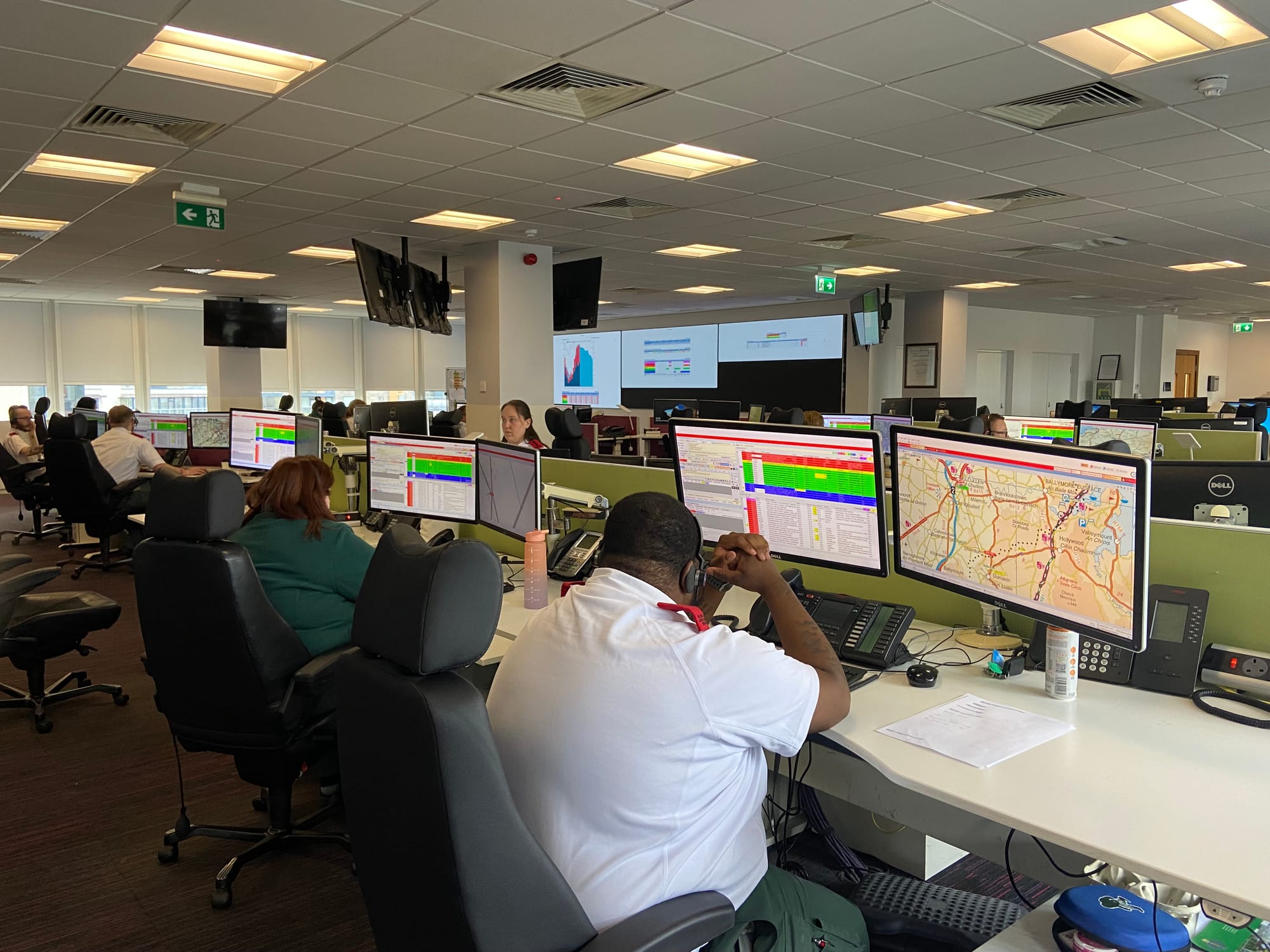
Call-takers use the Advanced Medical Priority Dispatch System, asking structured questions to assign one of six priority levels: Echo, Delta, Charlie, Bravo, Alpha and Omega. Echo, the most urgent, covers cardiac or respiratory arrest; Omega, the lowest, covers calls that may be queued or referred to alternative care. Each call-taker completes an eight-week initial training programme followed by four weeks of mentoring in a live environment.
Computer-aided dispatch, automatic vehicle location and a national TETRA radio network let controllers send the nearest available resource, and the call-taker can give pre-arrival instructions while you wait, including telephone CPR. The NAS provides statutory 999 ambulance cover nationwide, with one exception: in Dublin, Dublin Fire Brigade also provides an emergency ambulance service under agreement with the HSE.
How They Find You
Since 2017, Advanced Mobile Location has meant that a 999 or 112 call from a modern Android or iOS smartphone automatically sends the handset's best available location, drawn from GPS, Wi-Fi and mobile masts, to the ECAS. It needs no app and no manual activation, and accuracy is often within tens of metres.
Eircodes close the remaining gap. About 35% of Irish addresses are non-unique, which historically caused real operational problems for emergency services; an Eircode identifies one property exactly. The National Ambulance Service has built Eircodes into its dispatch system and the mobile data terminals in its ambulances, technology first rolled out in Cork and Kerry.
That is the thinking behind the "Know Your Eircode" message: check yours at Eircode Finder and make sure everyone in the house can say it. For people who are deaf, hard of hearing or speech-impaired, the 112 SMS service passes texts to the Gardaí, ambulance service, fire service or Coast Guard, and the requirement to register in advance was removed in the final quarter of 2021.
Myths Worth Busting
The most common misconception first: a phone with no SIM card generally cannot call 999 or 112 in Ireland, as SIM-less emergency calling has been blocked to curb untraceable hoax calls. The old handset in the glovebox is not a reliable emergency backup.
Both 999 and 112 work in Ireland, run in parallel and are handled identically, and 112 works across the EU. Callers are never charged, ambulance services provided by the NAS and Dublin Fire Brigade are free, and all networks must provide access to the emergency services free of charge.
What Comes Through the Door
According to HSE audit figures reported by The Irish Times in December 2024, the National Ambulance Service responds to more than 400,000 calls each year, employs more than 2,400 staff across 100 locations, and operates a 675-strong fleet including more than 300 emergency ambulances. Alongside those ambulances are rapid response vehicles, staffed by a single advanced paramedic and able to do everything an ambulance can except transport a patient. Intermediate care vehicles crewed by EMTs handle transfers, and a Motorcycle Response Unit operates from Ballyfermot in Dublin, with a unit also established in Cork City.
Not every call ends in an emergency department. Cork's Pathfinder service, run with Cork University Hospital, pairs an advanced paramedic with an occupational therapist or physiotherapist and launched on 29 March 2023. In its first year it responded to 1,023 calls involving older adults in Cork, with 67% able to remain safely at home, according to the hospital's one-year report, and over its first two years, to March 2025, 69% of 1,615 calls did not result in the patient being taken to hospital, per Age Friendly Ireland. The model has since expanded to Donegal, Galway, Limerick, Kerry, Carlow/Kilkenny, Waterford and Tallaght.
From the air, Ireland has two dedicated air ambulances, which together form the Emergency Aeromedical Service: one operated by the Air Corps from Custume Barracks in Athlone, the other flying from the base in north Cork, with National Ambulance Service paramedics on board both aircraft. The Rathcoole service, near Millstreet, began in 2019 as the country's first charity air ambulance, but the charity handed it over at the end of February 2023, and it is now fully funded by the HSE, run under the National Ambulance Service and operated by Gulf Med Aviation Services. Both aircraft are tasked centrally through the NAS 999/112 system, with Irish Coast Guard helicopters providing additional support from bases including Dublin, Waterford, Shannon and Sligo.
There is more to come in north Cork. Plans for a 24/7 air ambulance base at Rathcoole are set to proceed, after Cork County Council granted planning permission for a runway expansion in June 2026 and a single objection was withdrawn the following month. The development includes a new operations and paramedic base building and a new helipad.
The Neighbours Who Get There First
For the most time-critical calls, help may arrive before the ambulance. Community First Responders are volunteers dispatched simultaneously with the National Ambulance Service to calls within roughly a 5km radius, for cardiac arrest, chest pain, choking and stroke. As of September 2025 there were 341 CFR groups nationwide with over 4,000 volunteers, according to Emergency Services Ireland, and the NAS deployed 8,522 CFR responses between January and August 2025. A dedicated NAS CFR app was launched at the Respond 2025 conference in Mullingar on 27 September 2025, with national rollout from January 2026.
Cork has fresh proof of the model. Douglas CFR went live on 19 December 2025 and, according to CRITICAL, responded to 25 incidents in its first four weeks; by February 2026 the group had passed 40 call-outs, RTÉ reported.
CRITICAL, the emergency medical response charity behind that original Rathcoole air ambulance, began life in 2009 as Irish Community Rapid Response. Since 2023 it has partnered with the National Ambulance Service, funding equipment worth about €1,500 per volunteer so that off-duty ambulance staff can respond to nearby life-threatening emergencies through a scheme that has operated for almost 20 years.
David Tighe, CEO of CRITICAL:
"CRITICAL has a network of more than 300 volunteer responders active across Ireland... They responded to over 2,000 calls during 2025."
Communities that want a scheme of their own can start one through CFR Ireland and the NAS at becomeacfr.ie, a process involving registration, training to Pre-Hospital Emergency Care Council standards and Garda vetting. The NAS Community Engagement Team, led by National Community Engagement Manager Ger O'Dea, supports responder groups nationwide along with the rollout of the national Out-of-Hospital Cardiac Arrest Strategy.
Does the System Deliver?
Out-of-hospital cardiac arrest affects almost 3,000 people a year in Ireland, and survival to hospital discharge stands at 6-7%, against a European average of 8%, according to research covering 2012 to 2020. The 2023 OHCAR annual report shows why bystanders matter: of 2,857 cardiac arrests attended, members of the public defibrillated 304 patients, and 89 of those, 29%, survived. Bystander CPR was performed in 85% of cases in 2023, a rate that rose 25% between 2012 and 2023. The national cardiac arrest register, OHCAR, is chaired by Professor Conor Deasy, Clinical Director of Emergency and Acute Care at Cork University Hospital.
The system is also under real pressure. HSE data for January to September 2023 show around 72% of the most critically ill call-outs were reached within 19 minutes, slightly below the 75% target. Internal HSE reviews in 2023 and 2024 found demand growing faster than capacity, with the NAS identifying a need for more than 1,000 additional staff and reporting 2024 emergency call volumes up about 11% on record 2023 levels.
One Thing to Do Today
The technology behind an emergency call has never been better, from automatic phone location to a unique code for every front door in the country. It still works fastest when the person dialling can say exactly where help is needed. Look up your Eircode, learn it, and make sure the people you live with know it too.