Less Than a Quarter of Consumers Trust Black Friday Discounts, CCPC Survey Finds
Just 23% of Irish consumers trust Black Friday discounts, the lowest since 2022, as average expected spend falls to €307, a new CCPC survey has found.

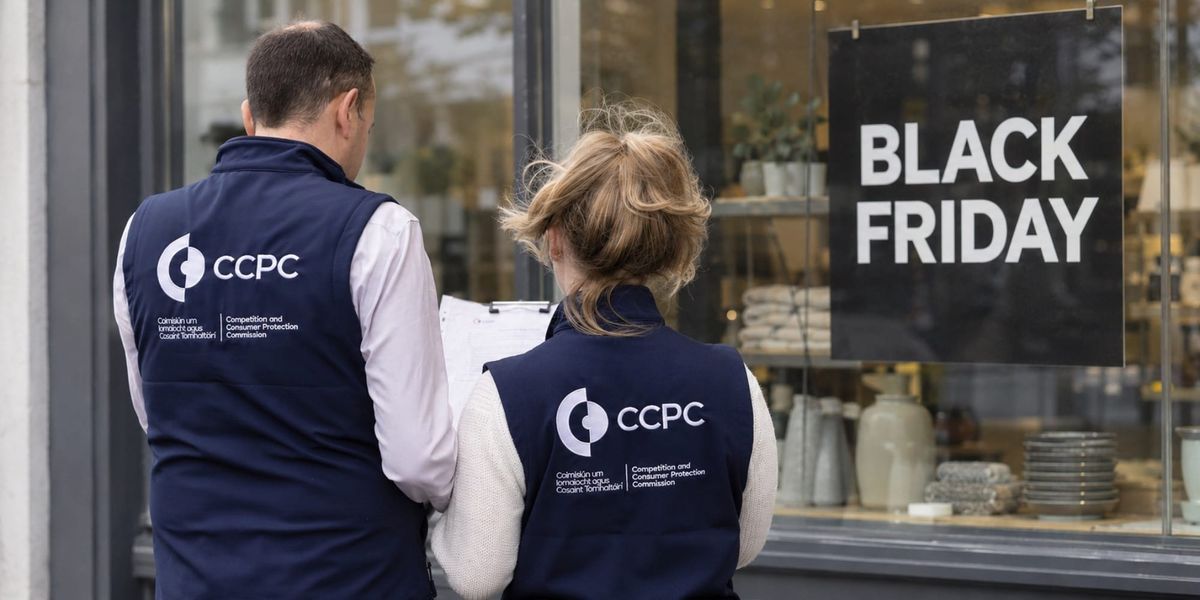
Trust in Black Friday discounts has fallen to its lowest level since the Competition and Consumer Protection Commission (CCPC) started its survey in 2022. Only 23% of consumers believe advertised discounts are accurate, and shoppers plan to spend less in this year’s sales.
The nationally representative survey of 1,028 Irish consumers found that the average expected spend has fallen to €307. That is the lowest since the survey began in 2022, and down from a high of €431 in 2024.
Nearly half of consumers (47%) say the cost of living has made them less likely to shop in the Black Friday sales. However, 26% say it will make them more likely to shop.
Scepticism is growing: 73% of consumers do not trust that discounts are accurate, compared with 61% when the survey began in 2022. Among those planning to shop in the sales, 80% say they will do research to check whether discounts are accurate before they buy.
New laws against misleading discounts were introduced in 2022. Since then, the CCPC has successfully prosecuted a number of high-profile traders, including Brown Thomas Arnotts, Boots, DID Electrical and Lifestyle Sports.
Aoibhín de Búrca, CCPC Director of Communications and Consumer Information:
“Consumers no longer trust that Black Friday sales are an opportunity to save money and they are becoming much savvier about sales. We’ve seen a noticeable decline in trust in discounts over the past five years; traders have some work to do to win back the trust of consumers.
Advertising false discounts is illegal. Recent CCPC investigations have led to significant court cases against traders for breaking sales pricing laws online and in store.”
Overall, 35% of consumers say they are likely to buy something during the Black Friday or Cyber Monday sales, down from 39% last year. Women are more likely than men to say they intend to buy something (38% vs 31%). Men, however, still expect to spend more than women (€356 vs €269).
As in previous years, clothing, footwear and jewellery (51%) and electronics (42%) top the shopping lists. Of those not planning to shop in the sales, 45% say it is because they don’t need or want anything, while 28% point to mistrust in deals and 26% say they can’t afford it.
Shoppers are also keeping an eye on the small print: 69% of those planning to shop in the sales will check the returns policy for some or all of their purchases.
Aoibhín de Búrca:
“These survey results show that many consumers are shopping carefully, conscious of getting value for money and using their consumer rights to navigate high costs. They’re checking return policies, shopping within the EU, and showing a healthy degree of scepticism around flashy discount claims.”
People are increasingly shopping exclusively online. Over half of intending shoppers (54%) say they will shop exclusively online, up from 41% in 2024. Of those planning to shop online in the sales, 92% intend to buy from traders based in Ireland.
There is a Munster angle too. While 90% of all respondents have bought something online, the report found Munster (85%) was among the groups with the lowest rates, along with those aged 55 and over (74%) and the DE social group (77%).
The survey also looked at newer habits. Among online shoppers, 11% have bought something on TikTok Shop. Almost 1 in 5 have bought something while under the influence of drugs or alcohol, with men (21%) more likely than women (15%) to say so.
Across all consumers surveyed, more than 1 in 2 (53%) have regretted an impulse buy made during a sale.
Aoibhín de Búrca:
“The good news for those who shop online and later regret their purchase is that as long as you’re buying from within the EU, you have 14 days to change your mind – and you’re entitled to a full refund if you do.
Buying from Ireland or elsewhere in the EU means your consumer rights are stronger, plus you’ll avoid the new EU customs charge and union handling fee. Always check where your bargains are being shipped from; if it’s not clear, that’s a red flag.”
Before buying, the CCPC advises consumers to research deals to check that the discount is real, to read reviews on Trustpilot or Google, and to make sure they know where their purchase will be shipped from.
If things go wrong, consumers can check their rights on CCPC.ie or contact the CCPC helpline at CCPC.ie/ask for advice. Anyone who has bought from outside Ireland can contact the European Consumer Centre Ireland.
Ipsos B&A designed the survey in consultation with the CCPC. It was carried out through telephone interviews with a representative sample of 1,028 people aged 15 and over, between 1 and 15 October 2026.