
Gardaí to Trial Tasers for Frontline Officers in Major Policy Shift
Cork watches as Dublin, Waterford trial begins this month.

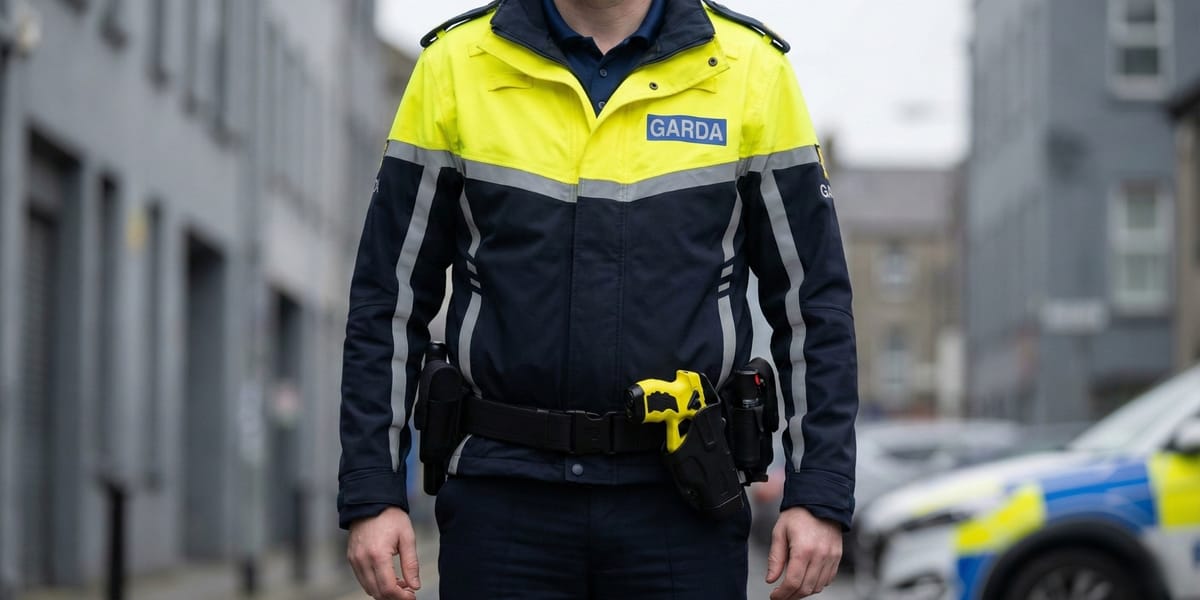
Cabinet has approved a six-month pilot programme to equip uniformed frontline gardaí with Tasers for the first time, marking a significant departure from Ireland's tradition of unarmed policing. While Cork is not included in the initial trial, the decision could shape the future of policing across the country.
128 Frontline Gardaí to Carry Tasers
According to The Journal, approximately 128 specially trained uniformed gardaí will be issued with Taser X26P devices as part of the pilot, which is set to begin this month. The trial will run in four divisions: Dublin South Central, Dublin North Central, Waterford and Kilkenny.
This represents a major expansion of Taser use within An Garda Síochána. While specialist units such as the Emergency Response Unit and Armed Support Units have carried Tasers, this is the first time the weapons will be issued to regular frontline officers responding to emergency calls. The first recorded use of a Taser by the Emergency Response Unit was in 2008.
The Taser X26P fires two barbed probes attached to wires, delivering a five-second electric shock designed to incapacitate a person temporarily. According to The Journal, the device sits at roughly the same level of force as a baton strike in internal training materials, below firearms but above empty-hand techniques.
Why Tasers, Why Now?
The decision follows sustained concerns about officer safety. According to The Journal, which cited internal Garda figures, an average of 299 gardaí were assaulted on duty each year between 2014 and 2024. In the 12 months leading up to the pilot announcement, nearly 1,000 attacks on gardaí were recorded, with approximately 300 classified as serious assaults.
Niall Hodgins, Vice President of the Garda Representative Association, described the pilot as "very welcome", citing the statistic of 1,000 attacks in the previous year. Representative bodies have long argued that frontline gardaí face a dangerous gap between batons and firearms when dealing with violent situations.
The pilot follows a review of equipment after the Dublin riots in November 2023, when the Garda Commissioner told the Oireachtas Justice Committee that stronger incapacitant spray would be issued to all gardaí, public order units would receive around 200 additional Tasers subject to training, and a business case would be made for water cannon.
Strict Oversight and Reporting Requirements
The pilot operates under a new oversight framework established by the Policing, Security and Community Safety Act 2024, which came into force in April 2025.
According to The Journal, every time a Taser is drawn, pointed or fired, officers must notify Fiosrú (the Office of the Police Ombudsman), even if the device is never discharged. If a Taser is fired, the person must be examined by a paramedic or doctor as soon as practicable.
Each use generates extensive documentation: a written report, download of the Taser's internal data recording time and duration of discharge, and body-worn camera footage. The pilot is restricted to divisions where body-worn cameras are already operational, ensuring digital accountability for every deployment.
The Policing and Community Safety Authority, which replaced the former Policing Authority, monitors patterns and trends in use of force under the 2024 Act. This creates a dual oversight system designed to prevent misuse while collecting comprehensive data on how Tasers are deployed in real-world situations.
Medical Risks and Civil Liberties Concerns
The expansion has sparked significant debate. The Irish Council for Civil Liberties has opposed the pilot, describing Tasers as "dangerous weapons" in a December 2025 statement titled "Tasers are not the Christmas gift Gardaí need". They warn against normalising Taser use in routine policing and call for robust human rights safeguards.
Medical reports from the UK's Scientific Advisory Committee on the Medical Implications of Less-Lethal Weapons highlight risks including cardiac complications, seizure induction and adverse effects in thin adults and children. The reports note that cardiac capture, where electrical pulses affect heart rhythm, is particularly dangerous for those with underlying heart conditions or shorter skin-to-heart distance.
The committee also warns of elevated risks for people under the influence of stimulant drugs or experiencing acute behavioural disturbance, conditions that gardaí frequently encounter in volatile situations.
What It Means for Cork
Cork is not part of the initial six-month trial. Specialist units covering the region, including Armed Support Units, continue to carry Tasers, but uniformed frontline gardaí in Cork will not be issued with the devices during this pilot phase.
However, any decision to expand Taser deployment nationally would depend on the outcome of the trial. Data collected over the next six months on use-of-force statistics, complaints to Fiosrú and assessments by the Policing and Community Safety Authority will determine whether Tasers become standard equipment for Irish police officers, including those serving Cork communities.
The pilot represents a careful first step in a debate that balances officer safety against civil liberties concerns, with implications for every community in Ireland.